
Pollution NOC Registration in Haryana
Ensure safety compliance and secure Pollution Department clearance for your building or business in Haryana with expert Pollution NOC assistance.
Haryana Pollution NOC Fee Calculator
Pollution NOC In Haryana Registration
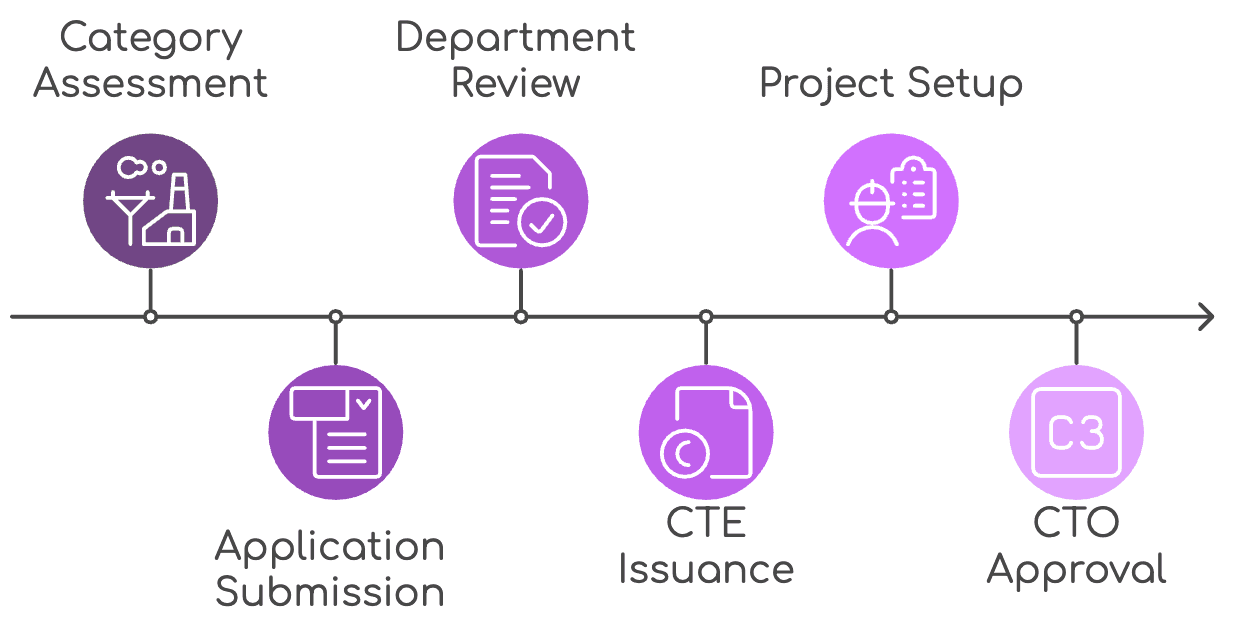
Without a pollution NOC in Haryana, a factory cannot be established or run. The NOC pollution control board in Haryana, or Haryana State Pollution Control Board (HSPCB), granted this licence in order to guarantee that the industry will not negatively impact the environment. Under the Water (Prevention & Control of Pollution) Act of 1974 and the Air (Prevention & Control of Pollution) Act of 1981, there are two NOCs: Consent to Establish (CTE) and Consent to Operate (CTO) that you need to obtain before establishing and operating a business.
Hire Factorylicence.in and ensure your Pollution NOC in Haryana with our comprehensive support. We also help the CTO pollution control board in Haryana. Get in touch with our consultant right now!
Why Pollution NOC In Haryana Important?
Pollution NOC for factory in Haryana is important because it is the licence that ensures that your business activity will not cause any harm to the surrounding environment by polluting it in any way. IF your factory is found running without a pollution NOC certificate in Haryana, then it will face legal charges, penalties, being court prosecuted, and even in some cases being shut down.
Through the expert assistance of Factorylicence.in getting the NOC from Pollution Control Board in Haryana will become easy. Register your query now!
Benefits Of Pollution NOC In Haryana
- Legal Safeguard: Pollution NOC protects your business from regulatory penalties and legal actions, ensuring operations remain uninterrupted.
- Credibility and Compliance: Holding a valid NOC enhances business reputation, proving your commitment to sustainability and legal adherence.
- Access to Other Approvals: It is a prerequisite for obtainingfactory licenses, building plan approvals and financial grants.
- Sustainability Goals: Helps implement eco-friendly practices, waste management systems and pollution control measures.
- Tender Eligibility: Required for participation in major government or institutional tenders, giving your business a competitive edge.
Factorylicence.in is one of the best legal service providers in Haryana. Our expert assistance can help you obtain all the Factory license you need to set up and operate a factory in Haryana.
Eligibility Criteria For Pollution NOC In Haryana
Any unit in Haryana that discharges effluents, emits air pollutants or handles hazardous substances must obtain a Pollution NOC. This includes industries under red, orange and green categories as classified by HSPCB, construction projects over a certain size, healthcare units and even some hospitality establishments.
HSPCB Classification:
- The white category industries have a pollution index of up to 20.
- For green, it is 21-40
- For orange, it is 41-59
- For red, it is 60 or above
Industries under the green, orange, and red categories are needed to apply for Consent to Establish and Consent to Operate under the Air and Water Act, while the industries falling under the white category just need to notify with an Understanding within 30 days from the Establishment of business to NOC pollution control board in Haryana.
Call us to get a Pollution NOC certificate in Haryana!
Documents Required For Pollution NOC In Haryana
- KYC documents of the applicant (Pan, Aadhaar, Voter ID, Passport, etc.)
- Email ID and mobile number of the applicant
- Address proof of unit (electricity bill/property documents)
- Project Report including process flow (Showing capital investment in Land & Plant Machinery)
- Site layout plan and land ownership documents
- List of raw materials and finished goods
- Details of water consumption and waste generation
- Authorisation for hazardous waste (if applicable)
- Consent application form (as per HSPCB format)
- Affidavits/Undertakings as prescribed
Step-by-Step Process For Pollution NOC Apply Online In Haryana
You have to go to the HSPCB website to register for the Pollution NOC in Haryana and fill out the online form according to the classification of HSPCB. Applying for the Pollution NOC in Haryana can be frustrating, so to help you, we have given the steps below. Just follow these steps:
- Registration & Application: Register as a new user on the HSPCB's OCMMS portal and submit your application for CTE or CTO.
- Document Submission: Attach required documents, including:
- CA Certificate.
- Site plan & Schematic diagram.
- Details of raw materials, production process, water usage, and waste generation.
- Proof of fee payment.
- Registration documents (MoA/Partnership Deed).
- Fee Payment: Pay the processing fee online, which varies by industry type and scale.
- Scrutiny & Inspection: HSPCB scrutinises the application; an inspection of your site follows.
- Approval/Rejection: If compliant, consent is granted; if incomplete, a show-cause notice is issued.
- Follow-up: Respond to notices and follow up with authorities to ensure a smooth process.
Fees For Pollution NOC In Haryana?
Typical HSPCB Fee Range:
- White Category: No fee
- Green Category: ₹5,000 – ₹15,000
- Orange Category: ₹10,000 – ₹50,000
- Red Category: ₹50,000 – ₹2,00,000
Note: Government fees are separate from consultancy charges.
Who Needs To Obtain The Pollution NOC In Haryana?
Every Industrial and commercial unit that generates emissions, effluents, or waste requires NOC from pollution control board in Haryana. This includes:
- The manufacturing units
- Health care establishments
- Traders
- E-waste management entities
- Solid waste management entities
- Hazardous waste management entities
- Battery waste management entities
- Plastic waste management entities
- Bio-medical waste management entities
Renewal Process of Pollution NOC in Haryana
The Pollution NOC is issued for a limited period. You have to renew it before the expiry date to continue your operations legally. Failure in renewing the NOC on time will cause you penalties or suspension of operations.
When Should Pollution NOC Renewal Be Applied?
- The renewal application should be filed at least 60 to 90 days before the expiry of the existing CTO.
- Operating with an expired NOC is treated as non-compliance, even if a renewal application is pending.
How To Apply For Pollution NOC Renewal In Haryana?
The renewal process of the Pollution NOC in Haryana is very similar to the process of registration for the Pollution NOC:
- You have to log in to the HSPCB's OCMMS portal with the existing credentials you created when applying for the pollution NOC first time.
- Then select the already registered industrial unit
- And navigate to the CTO renewal service,
- Click on it and fill in the details they will ask.
- Upload required documents ( the documents would be the same as the required when registering for the first time.
- Just one copy of the existing CTO certificate will be required; otherwise, all the documents will be the same, like before.
- At last, pay the renewal fees.
How much does It cost For Pollution NOC Renewal In Haryana?
The cost of Pollution NOC renewal is equal to or a percentage of the original CTO fee, based on:
- Industry category (Red/Orange/Green)
- Capital investment
- Duration of renewal
Penalties
Failure to obtain or renew a Pollution NOC can lead to heavy fines, closure of operations, disconnection of utilities, and even prosecution under environmental laws. In Haryana, HSPCB is vigilant and often initiates action against defaulting units.
Timelines
- CTE (Consent to Establish): 20 to 30 working days, depending on category and application completeness.
- CTO (Consent to Operate): 45 to 60 working days, post successful inspection and documentation.
- Renewal: 30 to 60 working days, post successful inspection and documentation.
Why Choose us?
Factorylicence.in provides various services like guidance in obtaining a factory license, fire NOC, and pollution NOC. With our professional assistance, Document preparation, fees, and security processing and renewal process become easy. Contact us and get the benefits of our expert consultation during HSPCB inspections for smooth verification.
Frequently Asked Questions
No. Operating without a valid CTO is illegal and can lead to immediate shutdown and penalties.
CTO is typically valid for 1 to 5 years, depending on the industry category.
Delay can result in a penalty, cancellation of the existing license and legal proceedings.
Usually, IT companies fall under the white category, which may not require a NOC, but this depends on activities and location.
You must apply immediately. Lawfinity can assist with legal rectification and compliance regularisation.
The Haryana State Pollution Control Board (HSPCB) is a statutory body of the Government of Haryana in India, established to protect the environment and to control pollution in the state. It is responsible for the implementation of various environmental laws and regulations in the state. The board is headed by a Chairman, who is appointed by the Government of Haryana. The board is also responsible for issuing environmental clearances for various projects in the state.
The Haryana State Pollution Control Board (HSPCB) provides a number of benefits to the citizens of Haryana. These include protecting the environment, controlling pollution, and ensuring sustainable development through the implementation of environmental laws.
H-category is a classification system used by the Haryana State Pollution Control Board (HSPCB) to categorise industries based on their pollution potential. Industries are classified into four categories: H1, H2, H3 and H4. H1 industries are those that have the highest potential to cause pollution, while H4 industries are those that have the least potential to cause pollution.
The Haryana State Pollution Control Board (HSPCB) has classified its industrial activities into four categories: H1, H2, H3 and H4. H1 industries are those that have the highest potential to cause pollution, while H4 industries are those that have the least potential to cause pollution. The classification is based on the type of activity, the amount of pollution generated, and the potential for environmental damage.
No, the Haryana State Pollution Control Board (HSPCB) does not grant consent to the industrial units located in non-conforming areas. Non-conforming areas are those areas which are not suitable for industrial activities due to their proximity to residential areas, water bodies, or other sensitive areas.