


Pollution NOC & Waste Management Authorization Consultant in Delhi
Ensure safety compliance and secure Pollution Department clearance for your building or business in Delhi with expert Pollution NOC assistance.
Delhi Pollution NOC Fee Calculator
Pollution NOC In Delhi Registration
Setting up and operating a factory will not be possible without a pollution NOC in Delhi. This license is issued by the Delhi Pollution Control Committee (DPCC) to ensure that the industry will not cause harm to the environment. There are two NOCs, viz., Consent to Establish (CTE) and Consent to Operate (CTO), under the Water (Prevention & Control of Pollution) Act, 1974, and the Air (Prevention & Control of Pollution) Act, 1981.
With Factorylicence.in you will get all-round assistance in getting a Pollution NOC for your business. Connect with our Consultant now!
Why Pollution NOC In Delhi Important?
The government will not allow you to run a factory if it is causing harm to the environment. To ensure that your business is not causing any kind of damage to the environment by polluting it in any way, you need to get a Pollution NOC. IF the business is found running without this pollution NOC, then it will face legal actions like fines, being court prosecuted, and even in some cases being shut down.
Benefits Of Pollution NOC In Delhi
- Legal Compliance: Ensures that your business adheres to pollution control norms as prescribed by environmental authorities, avoiding legal penalties.
- Environmental Responsibility: Demonstrates your organisation's commitment to environmental protection and sustainable practices.
- Smooth Operations: Helps in the uninterrupted operation of your unit without fear of closure or enforcement action.
- Credibility and Approvals: Required for applying for other licenses like factory license, fire NOC, building plan approvals, and more.
- Eligibility for Tenders: Mandatory for participating in many government or private tenders.
Eligibility Criteria for Pollution NOC In Delhi
Any industrial, commercial, healthcare, or construction unit intending to establish or operate within Delhi must obtain the Pollution NOC, especially if the activity falls under the red, orange, or green category as classified by DPCC. Even small businesses generating effluents, emissions, or hazardous waste need this certificate.
DPCC Classification:
- Orange Category- 73 Industries
- Red Category- 253 Industries
- Green Category- 120 Industries
- White Category- 203 Industries
Documents Required For Pollution NOC In Delhi
- KYC documents of the applicant
- Email ID and mobile number of the applicant
- Electricity bill or water bill for the premises
- Site plan/layout
- Manufacturing process details
- List of raw materials and products
- Consent application form
- Authorisation for hazardous waste (if applicable)
- Proof of land ownership or rent agreement
- Undertaking or affidavit as prescribed by DPCC
Consent to Establish (CTE) – Before Starting Operations
Consent to Establish (CTE) is an obligatory environmental approval issued by the State Pollution Control Board (SPCB) that permits an industry or project to establish a new facility or extend an existing one. This consent is necessary before any construction activity, installation of machinery, or operation that may cause pollution.
The Government of India has made it compulsory to obtain CTE to ensure that a project takes sufficient measures to control pollution right from the planning stage itself. By obtaining CTE, it becomes possible to avoid damaging the environment, achieve sustainable development, and comply with the relevant environmental laws.
Document list for the CTE:
- Covering letter clearly describing the business/industry & activities.
- PAN card of the owner/authorised person.
- Aadhar card of the owner/authorised person.
- GST Certificate (if applicable).
- Copy of the sale deed/rent agreement/lease deed (land proof).
- MOA/AOA or partnership deed (if company/partnership).
- Layout plan of the unit showing processing, utilities, and control devices.
- Schematic diagram or process diagram.
- Detailed manufacturing process description.
- Details of water & wastewater balance.
- Details of material balance.
- Land-use classification certificate.
- Auditor's certificate (CA certificate).
- Groundwater clearance certificate.
- Sewage Treatment Plant (STP) proposal (if applicable).
- Effluent Treatment Plant (ETP) proposal (if applicable).
- Air pollution control measures plan.
- Material Safety Data Sheets (MSDS) / risk assessment & emergency plan.
- Environmental Clearance (if applicable)
Consent to Operate (CTO) – After Establishing Unit
Consent to Operate (CTO) is an approval from the State Pollution Control Board (SPCB) that allows an industry or establishment to start or continue its operations after fulfilling the environmental compliance requirements. CTO is issued only after checking that the unit is installed and functioning with the required pollution control measures.
The purpose of the CTO is to ensure that the monitoring of emissions, effluents, and waste management practices is done continuously during the operational phase. The Government of India makes it mandatory to have a CTO to safeguard the health of the public and the environment by ensuring that industries operate in accordance with approved standards and conditions. Failure to have a CTO is considered a violation of the law for running a business that causes pollution.
Document list for the CTO:
- Copy of the issued CTE.
- Details of actual products manufactured.
- Audited balance sheet.
- Effluent/wastewater analysis report.
- Pollution control equipment performance data.
- Site compliance certificate & declaration.
Scrap Import Waste Management
Scrap import refers to the import of recyclable materials such as metal, paper, plastic, or electronic scrap for reuse, recycling, or recovery purposes. If not regulated properly, scrap imports may contain hazardous substances or non-compliant materials that can pose serious environmental and health risks.
To regulate this, the Government of India, under the Hazardous and Other Wastes (Management and Transboundary Movement) Rules, 2016, requires importers to obtain a Scrap Import Authorisation from the concerned authority. This authorisation ensures that only permitted and safe scrap materials are imported, handled, stored, and processed in compliance with environmental norms, thereby preventing illegal dumping and promoting safe and sustainable recycling practices.
The government has made authorities for the Aluminum scrap management Delhi, brass scrap management Delhi, copper scrap management Delhi, iron and steel scrap management Delhi. You need to get permission from the Scrap import waste management in Delhi to perform any commercial activity with these scraps.
Contact us if you want a Scrap import consultant Delhi.
Documents Required for Scrap Import Authorisation
(For import of metal scrap, plastic scrap, paper scrap, e-waste scrap, etc.)
- Application Form (SPCB / Online Portal)
- Import Export Code (IEC)
- Consent to Operate (CTO) from the State Pollution Control Board
- PAN Card of Importer / Company
- GST Registration Certificate
- Aadhaar & PAN of Proprietor / Directors / Partners
- Factory / Unit Registration Certificate
- Process flow chart for scrap utilisation
- Details of scrap type, category, and quantity to be imported
- Valid Chartered Engineer Certificate (from exporting country)
- Pre-shipment Inspection Certificate (PSIC), if applicable
- Layout plan of scrap storage and processing area
- Authorisation letter (if application filed through a consultant)
- Agreement with authorised recycler/processor (if applicable)
- Previous import details (if any)
- Site photographs of the factory and storage area
- CA Certificate for financial details
Steps To Apply For DPCC Pollution NOC
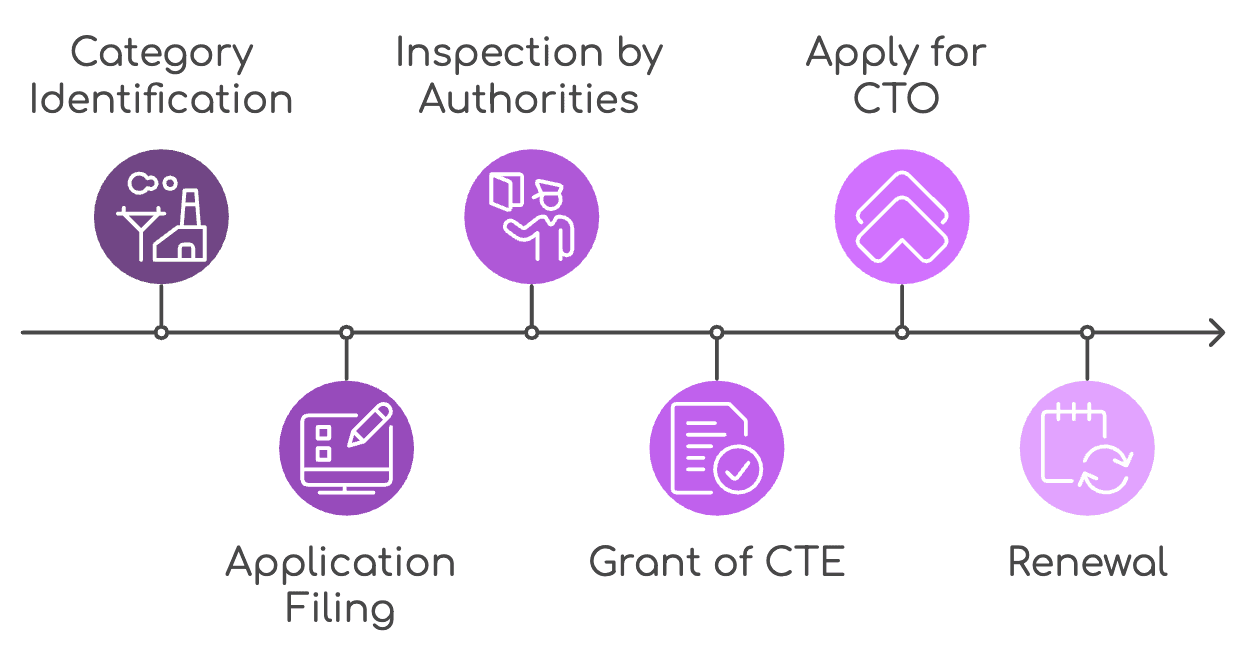
You have to go to the DPCC website to register for the Pollution NOC in Delhi and fill out the online form according to the classification of DPCC. Applying for the Pollution NOC can be frustrating, so to help you, we have given the steps below. Just follow these steps:
- Identify Applicability & Category: Understand if your industry needs a consent to establish (CTE) or consent to operate (CTO) from the Delhi Pollution Control Committee (DPCC). Industries are categorised (Red, orange, green) based on pollution.
- Documentation: Collect all the required documents and double-check to not miss any.
- Apply on the DPCC Portal:
- Visit the official DPCC website and create an account.
- Fill out the online application form for CTE or CTO.
- Upload Documents & Pay Fees: Upload scanned documents and pay the prescribed government fee online (fees vary by industry category and investment).
- Verification & Inspection: The DPCC scrutinises the application; officials may conduct a site visit to verify details and compliance.
- Receive NOC: Upon successful verification, the electronic NOC (CTE/CTO certificate) is issued, allowing legal operation.
Fees For Pollution NOC In Delhi
- White Category (Nil/Low Pollution): Often Nil or Self-Declaration.
- Green Category (Low Pollution): Fees range from ₹100 (for <₹5 lakh investment) up to ₹10,000 for CTE, and ₹200-₹20,000 for CTO, depending on capital.
- Orange Category (Medium Pollution): Fees increase with investment, e.g., ₹500 for CTE ( <₹5 lakh investment) up to ₹1,00,000 for CTE, and ₹1,000-₹2,00,000 for CTO.
- Red Category (High Pollution): Higher fees, starting from ₹25,000 for CTE up to ₹1,00,000, and ₹50,000 to ₹20,00,000 for CTO, based on investment.
Who Needs To Obtain The Pollution NOC In Delhi?
Businesses involved in these activities need to obtain the Pollution NOC:
- The manufacturing units
- Health care establishments
- Traders
- E-waste management entities
- Solid waste management entities
- Hazardous waste management entities
- Battery waste management entities
- Plastic waste management entities
- Bio-medical waste management entities
Factorylicence.in also assists in getting a Factory license in Delhi, Uttar Pradesh and Haryana. Contact us if you want to apply for any of these places.
Renewal Process Of Pollution NOC In Delhi
The Pollution NOC is issued for a limited period. You have to renew it before the expiry date to continue your operations legally. Failure in renewing the NOC on time will cause you penalties or suspension of operations.
When Should Pollution NOC Renewal Be Applied?
- The renewal application should be filed at least 60 to 90 days before the expiry of the existing CTO.
- Operating with an expired NOC is treated as non-compliance, even if a renewal application is pending.
How To Apply For Pollution NOC Renewal In Delhi
The renewal process of the Pollution NOC in Delhi is very similar to the process of registration for the Pollution NOC:
- You have to log in to the DPCC portal with the existing credentials you created when applying for the pollution noc first time.
- Then select the already registered industrial unit
- And navigate to the CTO renewal service,
- Click on it and fill in the details they will ask.
- Upload required documents (the documents would be the same as the required when registering for the first time.
- Just one copy of the existing CTO certificate will be required; otherwise, all the documents will be the same, like before.
- At last, pay the renewal fees.
How much does it cost for Pollution NOC Renewal in Delhi?
The cost of Pollution NOC renewal is equal to or a percentage of the original CTO fee, based on:
- Industry category (Red/Orange/Green)
- Capital investment
- Duration of renewal
Penalties
Operating without a Pollution NOC may result in heavy penalties, disconnection of utilities, legal prosecution, and closure of the unit. The fine amount depends on the category of the industry and the nature of the violation. Repeat violations can also lead to the cancellation of the license and blacklisting.
Timelines
- CTE (Consent to Establish): 20 to 30 working days, depending on project size and category.
- CTO (Consent to Operate): 45 to 60 working days, post successful inspection and documentation.
- Renewal: 30 to 60 working days, post successful inspection and documentation.
How can we help you?
We have been in this business of helping people get a legal license for their business for a long time. We provide help in obtaining different legal licences required for different types of businesses.
In this case of getting pollution NOC in Delhi, our professional consultant team will guide you in drafting the application for NOC, arranging and providing the required documents. Applying for a Pollution NOC will become easy with our end-to-end assistance.
Frequently Asked Questions
Yes, if the unit emits any kind of pollution (air, water, hazardous waste), it must obtain the NOC.
CTE is required before setting up the unit, while CTO is required before actual operations begin.
It is issued by the Delhi Pollution Control Committee (DPCC).
The validity of CTO ranges from 1 to 5 years, depending on the industry type and DPCC’s discretion.
No, you must first obtain CTE, complete the setup and then apply for CTO.
It is considered a serious offence and may lead to penalties, closure or legal action.
Yes, failing to renew the CTO before expiry can halt operations and attract fines.
Yes, if conditions are violated or if false information is provided.